Gene's Footnotes

I have never been impressed by the messenger and always inspect the message, which I now understand is not the norm. People prefer to filter out discordant information. As such, I am frequently confronted with, "Where did you hear that...." Well, here you go. If you want an email version, send me an email.

December 23, 2009

Great White #2

First, in Canada today's Financial Post, Business Section large headline:  


U.S. DEFICIT THREAT LOOMS


Flaherty worries shortfall could 
have 'serious' impact on Canadian economy


At least someone is paying attention to the U.S. collapse.  Canada is working to survive our insanity. They seem to think there are only two things that we can do. Either alone or together:  stop spending or tax less. Jerks. There is the Obama option:  raise taxes, cost of government, borrowing, transfers to friends, and spending.  There was a piece reporting on John Hussman's crazy notion that Geithner and Bernanke are premature in their "mission accomplished" events. He is a Maryland economist with a fund.  


The paper reports that in 2012 the U.S. deficit will be more than 100 percent of the GDP.  Canada's will max out 2010 at 79%. Of course, the proposed socialist taxes on everything will kick in about that time, as well.
-----


I am trying to figure out when to leave Toronto, an inter-storm exit.  I see Europe is also being blanketed by snow.  From a climatological perspective, we remain in the scientifically settled Gore Effect. 


I think we were in an El Nino year, but haven't checked.  That, coupled with no sun spots this year, until recently, Florida will likely have a freeze or tow, so buy orange juice.  Or, its futures.


Rod sent in a piece from the National Post, again Canadian, from the Deniers series.  I will quote a bit.  You can hit the title to get to the full story.  This piece will go along with what I stated, as a non scientist, long ago.  Once the cat is out of the bag, those socientists who want to keep their reputations will become, if not deniers, then insipid doubters. Of course, this article is over two years old, so the cat has been wiggling out for some time.

Within the article are the links to other parts of the series.  Again, recall this is over two years old.  


Allegre's second thoughts

Claude Allegre, one of France's leading socialists and among her most celebrated scientists, was among the first to sound the alarm about the dangers of global warming.

BY NATIONAL POSTMARCH 6, 2007


Claude Allegre, one of France's leading socialists and among her most celebrated scientists, was among the first to sound the alarm about the dangers of global warming.
"By burning fossil fuels, man increased the concentration of carbon dioxide in the atmosphere which, for example, has raised the global mean temperature by half a degree in the last century," Dr. Allegre, a renowned geochemist, wrote 20 years ago in Cles pour la geologie.." Fifteen years ago, Dr. Allegre was among the 1500 prominent scientists who signed "World Scientists' Warning to Humanity," a highly publicized letter stressing that global warming's "potential risks are very great" and demanding a new caring ethic that recognizes the globe's fragility in order to stave off "spirals of environmental decline, poverty, and unrest, leading to social, economic and environmental collapse."
The full Deniers series
Statistics needed -- The Deniers Part I
Warming is real -- and has benefits -- The Deniers Part II
The hurricane expert who stood up to UN junk science -- The Deniers Part III
Polar scientists on thin ice -- The Deniers Part IV
The original denier: into the cold -- The Deniers Part V
The sun moves climate change -- The Deniers Part VI
Will the sun cool us? -- The Deniers Part VII
The limits of predictability -- The Deniers Part VIII
Look to Mars for the truth on global warming -- The Deniers Part IX
Limited role for C02 -- the Deniers Part X
End the chill -- The Deniers Part XI
Clouded research -- The Deniers Part XII
Allegre's second thoughts -- The Deniers XIII


In the 1980s and early 1990s, when concern about global warming was in its infancy, little was known about the mechanics of how it could occur, or the consequences that could befall us. Since then, governments throughout the western world and bodies such as the United Nations Intergovernmental Panel on Climate Change have commissioned billions of dollars worth of research by thousands of scientists. With a wealth of data now in, Dr. Allegre has recanted his views. To his surprise, the many climate models and studies failed dismally in establishing a man-made cause of catastrophic global warming. Meanwhile, increasing evidence indicates that most of the warming comes of natural phenomena. Dr. Allegre now sees global warming as over-hyped and an environmental concern of second rank.

His break with what he now sees as environmental cant on climate change came in September, in an article entitled "The Snows of Kilimanjaro" in l' Express, the French weekly. His article cited evidence that Antarctica is gaining ice and that Kilimanjaro's retreating snow caps, among other global-warming concerns, come from natural causes. "The cause of this climate change is unknown," he states matter of factly. There is no basis for saying, as most do, that the "science is settled."...


Labels: , , , ,

May 28, 2009

Bilderbergers Meet Again


Just a short one for tired readers.

Ray sent me the context of Sotomayor's remarks about Latina. I will drop it in here next time. Not having read the context, yet, I am interested in the notion that what she said could be out of context. If it is, it will be a classic example of how one (me) should not assume excerpts mean what they say. I should never rely on journalists, anyway, but you can't look everything up.

The key is what her view of a judge is. I think most people don't understand they are not responsible to find fact, they are responsible to conduct matters according to due process. That is what is meant by not making law. It is one thing for Congress to make a law, which can be reviewed under Constitutional provisions, but another for the Court to do it, such as the Roe v. Wade case, which is a departure from the role of the Court.

The majority made up new law because the majority wanted the result, not because it was supportable by precedent. The Vermont Supreme Court made up the social contract (there are non lawyers on the court) by deciding it flows from the Dred Scot decision. This makes zero sense. To understand the system, now realize that present judges who are conservative, with a small c, will give deference to Roe, etc., as it is precedent. The weird Vermont decision was not reviewable by anyone, even the U.S. Supreme Court, so it made up law. To its detriment, the legislature just shuffled along.

As Greg says, in a means analysis, the legislature should have ignored the instruction to create a law that met the Court's decision (I am not making this up) and should have rejected the usurping of power. The legislature is free to make laws, but it has to defend its own turf.

Chief Judge Roberts testified at his hearings that as a Court member, he must apply law and precedent (which can be changed if a proper case is brought) and Roe is law regardless of any personal opinion. This is what I call system's analysis, the proper way to protect the Constitution.

Judicial activists say - Oh the Constitution is so old and made up by dead white men, so we can change things to make them modern, for example, that, for some magical reason, abortion is legal for three months. Why? Activists wanted the outcome, bringing in their own views and desires, and do back flips to sound like they are traditional jurists. This is ends analysis is, to my mind, the end of the grand experiment. Ends analysis is anarchy and tyranny. The government will do what it can get away with, then it won't care, as it will have control.

So, I will see what Sotomayor thinks. The quote being used these days suggests she wants to make law based on her sex and personal experience. That is anathema to the conservative, so that may be why it was lifted and promulgated. Her personal experience is irrelevant to a traditional jurist's mind. In fact, she would be highly regarded when her personal opinions are unknown or put aside; they have no place in judicial work. I will get to this soon.

I recall one case from law school where this point was made. In a criminal case the defendant said he was at a certain location to make a night deposit. The Judge knew there was no bank deposit box at that bank, so in his rulings he had the testimony, essentially, destroyed. The appeal court said, no - you do not bring in you knowledge; it is not your job. The lawyers dig out the facts and offer evicence to the jury. Sure, mistakes can be made, but do you want judges telling the jury what to think?

(Ray, looks like a good kayak place at 2123 Central Ave, Albany called Paddle 'n Pole.)
------

Here is an interesting report on the current Bilderberg meeting.

I like the notion that people assume that this talk about the Bilderbergers, the CFR, and so on is part of some nut conspiracy and don't even try to put 1 and 1 together. Now, if you say evil Republicans are meeting to make money, then you have a Congressional hearing. There must be a way to make money on self-imposed blinders. Gold, I guess, but they can take that away. A puzzlement.

Below, note the talk was of a short crash, rather than a long one. If the "recession" is short it must be deep to meet the goals of creating chaos......new government. If you apply this filter to what has happened in the past few years, especially this year, it is obvious what is going on. This clarity lends credibility to the filter, though doesn't prove it.

An excerpt for fun:

..Shortly after the meetings began, Bilderberg tracker Jim Tucker reported that his inside sources revealed that the group has on its agenda, “the plan for a global department of health, a global treasury and a shortened depression rather than a longer economic downturn.”


Tucker reported that Swedish Foreign Minister and former Prime Minister, Carl Bildt, “Made a speech advocating turning the World Health Organization into a world department of health, advocating turning the IMF into a world department of treasury, both of course under the auspices of the United Nations.” Further, Tucker reported that, “Treasury Secretary Geithner and Carl Bildt touted a shorter recession not a 10-year recession ... partly because a 10 year recession would damage Bilderberg industrialists themselves, as much as they want to have a global department of labor and a global department of treasury, they still like making money and such a long recession would cost them big bucks industrially because nobody is buying their toys.....the tilt is towards keeping it short.”[2]


After the meetings finished, Daniel Estulin reported that, “One of Bilderberg’s primary concerns according to Estulin is the danger that their zeal to reshape the world by engineering chaos in order to implement their long term agenda could cause the situation to spiral out of control and eventually lead to a scenario where Bilderberg and the global elite in general are overwhelmed by events and end up losing their control over the planet.”[3]


On May 21, the Macedonian International News Agency reported that, “A new Kremlin report on the shadowy Bilderberg Group, who this past week held their annual meeting in Greece, states that the West’s financial, political and corporate elite emerged from their conclave after coming to an agreement that in order to continue their drive towards a New World Order dominated by the Western Powers, the US Dollar has to be ‘totally’ destroyed.” Further, the same Kremlin report apparently stated that, “most of the West’s wealthiest elite convened at an unprecedented secret meeting in New York called for and led by” David Rockefeller, “to plot the demise of the US Dollar.”[4]


The Secret Meeting of Billionaires

The meeting being referred to was a secret meeting where, “A dozen of the richest people in the world met for an unprecedented private gathering at the invitation of Bill Gates and Warren Buffett to talk about giving away money,” held at Rockefeller University, and included notable philanthropists such as Gates, Buffett, New York Mayor Michael Bloomberg, George Soros, Eli Broad, Oprah Winfrey, David Rockefeller Sr. and Ted Turner.... [This part of any conspiracy needs a mild suspension of belief, I should think, but not a dismissal.)
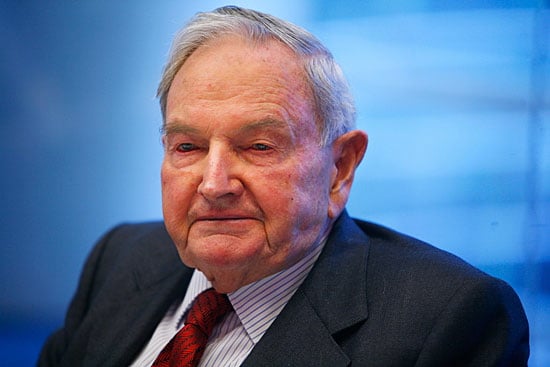


Bilderberg founding member David Rockefeller, Honourary Chairman of the Council on Foreign Relations, Honourary Chairman and Founder of the Trilateral Commission, Chairman of the Council of the Americas and the Americas Society, former Chairman and CEO of Chase Manhattan.


Labels: , ,

March 25, 2009

Brown Shirts, commercial framing, and economic chaos


The kill-off-organic-and-home-farm bill is still moving along, as is the Brown Shirt bill. It is a really good idea for the Post Office to control our food supply.  Your visit to the farmer's coop will be different. Vendors will watch you warily, lest you are an inspector. (There is a penalty of up to $1 million and jail time if you don't do what the government tells you, like use Monsanto chemicals.)

Under the pending Brown Shirt bill, if a school takes federal money, it must include in all classes the Brown Shirt curriculum.  A group is set up to study the creation of a mandatory membership in the Brown Shirts. I think I read about that in the Constitution.

I hope you see how the government is nothing but a pusher - and it is using your money to hook you.

So what, the NCAA is on.  Who cares.  Right. You can always write a letter to you Congressperson after your grandchildren report to their teachers about your carbon use and unplusgood thoughts. 

Some light reading, for a change: 

Part I: Geithner's Plan "Extremely Dangerous," Economist Galbraith Says

Posted Mar 23, 2009 11:08am EDT by Henry Blodget in Investing, Newsmakers, Recession, Banking

From The Business Insider, March 23, 2009:

Tim Geithner has finally revealed his plan to fix the banking system and economy. Paul Krugman, James Galbraith, and others have already trashed it.

[We spoke with noted economist Galbraith this morning. In the accompanying segment, he calls the Treasury Secretary’s plan “extremely dangerous.”]

Why?

In short, because the plan is yet another massive, ineffective gift to banks and Wall Street. Taxpayers, of course, will take the hit

Why does Tim Geithner keep repackaging the same trash-asset-removal plan that he has been trying to get approved since last fall?

In our opinion, because Tim Geithner formed his view of this crisis last fall, while sitting across the table from his constituents at the New York Fed: The CEOs of the big Wall Street firms. He views the crisis the same way Wall Street does--as a temporary liquidity problem--and his plans to fix it are designed with the best interests of Wall Street in mind.

If Geithner's plan to fix the banks would also fix the economy, this would be tolerable. But no smart economist we know of thinks that it will.

We think Geithner is suffering from five fundamental misconceptions about what is wrong with the economy. Here they are:

The trouble with the economy is that the banks aren't lending. The reality: The economy is in trouble because American consumers and businesses took on way too much debt and are now collapsing under the weight of it. As consumers retrench, companies that sell to them are retrenching, thus exacerbating the problem. The banks, meanwhile, are lending. They just aren't lending as much as they used to. Also the shadow banking system (securitization markets), which actually provided more funding to the economy than the banks, has collapsed.

The banks aren't lending because their balance sheets are loaded with "bad assets" that the market has temporarily mispriced. The reality: The banks aren't lending (much) because they have decided to stop making loans to people and companies who can't pay them back. And because the banks are scared that future writedowns on their old loans will lead to future losses that will wipe out their equity.

Bad assets are "bad" because the market doesn't understand how much they are really worth. The reality: The bad assets are bad because they are worth less than the banks say they are. House prices have dropped by nearly 30% nationwide. That has created something in the neighborhood of $5+ trillion of losses in residential real estate alone (off a peak market value of housing about $20+ trillion). The banks don't want to take their share of those losses because doing so will wipe them out. So they, and Geithner, are doing everything they can to pawn the losses off on the taxpayer.

Once we get the "bad assets" off bank balance sheets, the banks will start lending again. The reality: The banks will remain cautious about lending, because the housing market and economy are still deteriorating. So they'll sit there and say they are lending while waiting for the economy to bottom.

Once the banks start lending, the economy will recover. The reality: American consumers still have debt coming out of their ears, and they'll be working it off for years. House prices are still falling. Retirement savings have been crushed. Americans need to increase their savings rate from today's 5% (a vast improvement from the 0% rate of two years ago) to the 10% long-term average. Consumers don't have room to take on more debt, even if the banks are willing to give it to them.

The two charts below from Ned Davis illustrate the real problem: An explosion of debt relative to GDP. The first is Nonfinancial Debt To GDP. The second is Total Debt To GDP.

In Geithner's plan, this debt won't disappear. It will just be passed from banks to taxpayers, where it will sit until the government finally admits that a major portion of it will never be paid back.

For more coverage including charts, see The Business Insider.


Part II: Geithner, Obama Kowtowing to "Massively Corrupted" Banks, Galbraith Says

Posted Mar 23, 2009 12:07pm EDT by Aaron Task in Newsmakers, Banking
Like it or not, many people seem to be resigned to the idea there's no alternative to the public-private investment fund scheme Treasury Secretary Geithner detailed this morning. (Click here for part one of our discussion of the plan.)

That's hogwash, says University of Texas professor James Galbraith, author of The Predator State. Of course there's an alternative: FDIC receivership of insolvent banks.

Aside from being legally proscribed, the upside of FDIC receivership is the banks are restructured and reorganized for potential sale (either in whole or parts), Galbraith says. Such was the fate in 2008 of, most notably, Washington Mutual and IndyMac.

Crucially, FDIC receivership also means new management teams for insolvent banks; and Galbraith notes new leaders will have no incentive to cover up the fraudulent or predatory lending practices of their predecessors. Given the entire system was "massively corrupted by the subprime debacle," the professor believes criminal prosecutions on par with the aftermath of the S&L crisis - when hundreds of insiders went to jail - is a likely (and necessary) outcome of the current crisis.

But don't expect to see many "perp walks" if Geithner's current plan comes to fruition. That's one reason Galbraith called the plan "extremely dangerous" in part one of our interview.

So why isn't the Obama administration pushing for FDIC receivership? "Political influence of big banks," the economist says.

----

One Small Problem with Geithner's Plan: It Will Bankrupt the Banks

Posted Mar 25, 2009 09:54am EDT by Henry Blodget in Investing, Recession, Banking

From The Business Insider, March 25, 2009:

The big problem with Tim Geithner's plan to fix the banks is the same as it ever was: The gap between what banks say their assets are worth and what the market says they are worth.

When a bank says an asset is worth 60 cents and the market says it's worth 30 cents, someone has to cover that spread. The genius of Geithner's plan is that it pawns most of the cost (and most of the risk) off on the taxpayer without the taxpayer noticing.

But unless the taxpayer gets stuck with the entire spread, which is probably what Geithner is hoping, banks that sell assets will have to take massive writedowns. This will start the whole cycle of violence again.

This risk to the banks is particularly acute when dealing with whole loans that the banks currently say they have no plans to sell. These loans are often carried at 100 cents on the dollar, because loans classified as held to maturity don't have to be marked to market. Even subsidized buyers won't likely be willing to pay anywhere near 100 cents on the dollar for these loans. So, here, the writedowns could potentially be huge.

And then there's another problem:

If the banks go through the exercise of putting assets up for sale only to have the bids come in at, say, 40 cents instead of the 60 cents on the books, the banks' accountants and/or federal regulators might notice. So even if the banks recoil in horror and refuse to sell at 40 cents, someone somewhere might insist that assets now carried at 60 cents be written down to 40 cents (after all, they won't have the "temporary illiquidity discount" excuse anymore, will they?). This will blow another huge hole in the banks' balance sheets.

Given this, banks would probably be wise not to participate in Geithner's plan. Which is why the government is already talking about forcing them to:

FT: “The unspoken fear here is that selling off loan portfolios would lead to more government capital injections into major banks,” said an executive at a large bank...

Richard Bove, an analyst at Rochdale Research, wrote in a note to clients: “[The plan] will not happen because it would destroy bank capital. It might cause a bank to fail the new stress tests under way. Banks will not take this risk.”

But while banks in theory have discretion over whether to sell loans, Sheila Bair, chairman of the Federal Deposit Insurance Corporation, said this decision would be made “in consultation with regulators” – a sign that the authorities might put pressure on banks to sell toxic assets.

It's time to face the fact that we have already de facto nationalized the big banks--and that the way we've done it is worse than standard receivership and restructuring. The longer we remain in denial about this, the worse off we'll be. But that's another story...

For more coverage, see The Business Insider.


Labels: , , ,